
Two things are true about the modern B2B software buyer, and they cannot both be satisfied by your current funnel. One: they want to experience the product — really see it, poke at it, test it against their use case — before they'll shortlist you. Two: they do not want to talk to your sales team to get that experience. That's the buyer demo paradox, and most funnels resolve it in the worst possible way: by making the demo the prize for enduring the sales contact buyers were trying to avoid.
The resolution isn't picking a side. It's making the demo itself conversational without making it human-gated — book a demo to see what that looks like.
Buyers now switch vendors mid-evaluation — at scale
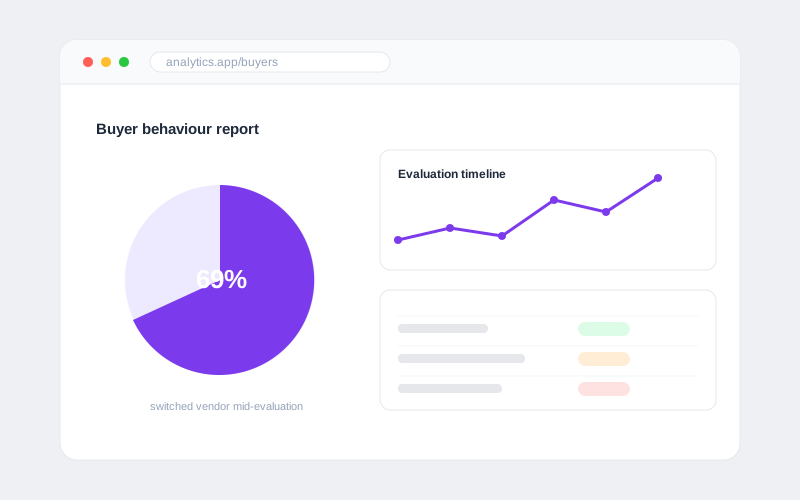
The sharpest evidence of how little control vendors now have over their own evaluation comes from G2's recent buyer research: 69% of buyers chose a different software vendor than they initially planned, based on guidance from AI chatbots during their research (G2, "The Answer Economy", surveying ~1,900 software buyers). A third went on to purchase a product they discovered through an AI tool entirely.
Read that against your funnel design. The buyer who filled in your demo form on Monday is, statistically, more likely than not to be persuadable away from you by Thursday — by an AI summary, a competitor's better self-serve experience, or simply whoever answers their questions fastest. Every day your demo sits behind a calendar link is a day that persuasion happens somewhere else.
How the paradox formed
Self-serve became the norm everywhere else. The same person deciding on your software signs up for consumer products in ninety seconds. Waiting three days for a scheduled walkthrough feels archaic because it is.
The sales call stopped being the information source. Docs, review sites, communities, and now AI assistants answer most evaluation questions before a rep is ever involved. What's left for the first call is often just… the demo. Which raises the obvious question buyers keep asking: why is a human required for this?
But products got more complex, not less. Here's the twist that keeps the paradox alive: buyers still need the interactive, question-answering experience a good demo call provides. A pricing page and a feature list don't answer "will this work with our stack?" Self-serve content is one-way; complex purchases generate two-way questions.
So buyers want the substance of a great sales conversation with none of the sales contact. That's the paradox in one sentence.
The half-fixes
Ungated tour, gated answers. Interactive click-through demos show the product but can't respond — the buyer's actual questions still queue for a human. We've mapped that ceiling in interactive product demo vs live conversation.
Faster gates. Speed-to-lead tooling gets a rep on the phone in minutes instead of days. Better — but it still resolves the paradox by forcing the contact buyers didn't want, just sooner.
No gate, no signal. Fully self-serve trials satisfy the buyer but tell your sales team nothing. Qualification disappears entirely, and with it your ability to prioritise.
The actual resolution
The paradox dissolves when the demo is a live conversation that isn't a sales contact. A voice-first AI agent — trained on your product, docs, and playbooks — gives every visitor the two-way experience they came for: real demo, real answers, real objection handling. And because it's a conversation, it does what no tour can: it runs discovery and scores the buyer against your ICP while it educates them. The buyer gets self-serve; you get qualification. Nobody waited, and nobody got cornered by a rep.
That's the model Sonesse is built on — the demo as the entry point of the funnel rather than its reward, with humans stepping in only once a buyer is scored, warm, and worth the time.
Audit your own funnel for the paradox
Three questions expose how badly the paradox is costing you. How long does a buyer wait between requesting a demo and seeing the product — minutes, or days? What happens to their questions in that gap — answered by you, or by whatever AI summary and competitor content they find first? And when the human call finally happens, how much of it is spent on things a good self-serve experience should already have covered? If the answers are "days," "not by us," and "most of it," the 69% switching statistic isn't an industry curiosity — it's a description of your pipeline leak.
The takeaway
The 69% switching stat isn't a curiosity — it's the cost of latency. Evaluations are now decided in the gaps between your touchpoints, by whoever answers the buyer's questions in the moment they're asked. Close the gap: put a conversation where your demo gate used to be.
Book a demo and ask it your hardest question.