
Every demo request looks the same in your inbox. Behind them, though, are three very different people: the buyer with budget and a deadline, the researcher gathering screenshots for a deck, and the student writing a comparison paper. Your AEs spend the same thirty minutes on each of them — and only find out which one they got at minute twenty-five.
Qualifying demo requests automatically means finding out before a human joins the call. Here's how teams actually do it, from the crude to the conversational. Or skip ahead and book a demo of the approach we'd recommend.
Level 1: Longer forms
The default move is adding fields to the demo request form — company size, role, use case, timeline. It works, in the sense that some unqualified requests give up halfway through. But it fails in two directions at once. Serious buyers resent the interrogation and abandon it too, and everyone else has learned exactly which dropdown options get them a meeting. Form data is self-reported by people who want something from you; it's the least reliable qualification signal there is.
Level 2: Enrichment and lead scoring
The next step up is enrichment: match the email domain against firmographic data, score the account, and route accordingly. This is genuinely useful for filtering out obvious mismatches — free email domains, companies far outside your segment. But enrichment tells you about the company, not the buyer. It can't tell you whether this particular person has a problem you solve, a timeline, or any authority to buy. A perfectly ICP-matched account can still send you someone six layers from the decision.
Level 3: Interactive demos and intent signals
Click-through product tours — the Storylane and Navattic category — add behavioural signal on top. You see which features a prospect explored and where they dropped off, which beats form data. But engagement is not qualification. Someone can click through your entire tour out of curiosity, and someone with urgent budget can bounce after two screens because the tour didn't answer their one question. You still don't know pain, timeline, or fit — the things a discovery call exists to uncover. We've written more about that gap in interactive demos vs live conversation.
Level 4: Qualification through conversation
The questions that actually qualify a buyer — what's driving this now, what are you using today, when do you need it live, who else is involved — can only be asked in a conversation. That used to mean a human SDR call, which is exactly the bottleneck you're trying to remove.
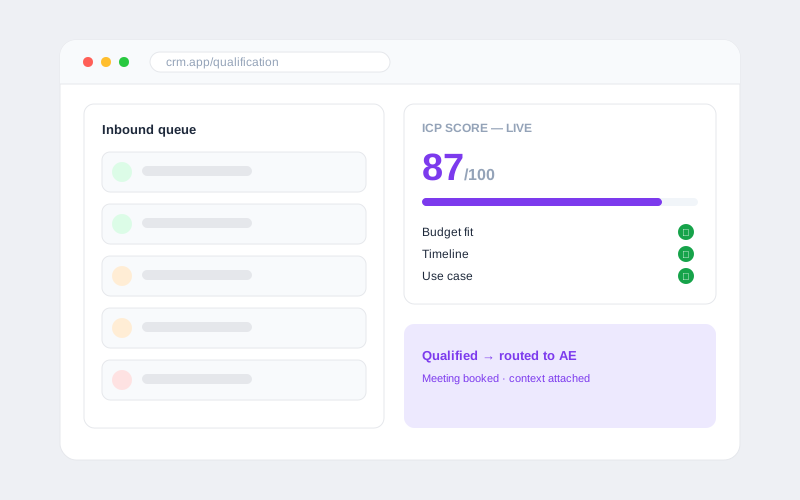
A conversational AI agent removes it. When a prospect clicks your demo link, Sonesse starts a live, voice-first conversation immediately: it demos the product, answers their specific questions, and runs discovery in the same exchange — scoring the buyer against your ICP in real time. No form. No calendar hand-off. No human minutes spent on the researcher or the student.
What automatic scoring looks like in practice
- Define your ICP in plain English — company profile, pain points you solve, disqualifiers. The agent screens through conversation, not a form.
- Every conversation produces a score — budget fit, timeline, use-case match, seniority — captured from what the buyer actually said.
- Qualified buyers route instantly — booked onto an AE's calendar warm, with the full conversation context attached.
- Everyone else still gets value — a real demo and real answers — without costing your team a minute.
Rolling it out without breaking your funnel
You don't have to rip out your existing flow on day one. The lowest-risk rollout is to run the conversational layer in parallel: keep your current form-and-calendar path, and add a "talk to us now" option beside it. Within a couple of weeks you'll have a clean comparison — conversion rate, time-to-first-demo, and the quality of what reaches your AEs from each path. In practice the instant path wins so decisively that the form quietly becomes the fallback for buyers who explicitly prefer async. From there, tighten the loop: review the first fifty conversation transcripts, adjust your ICP definition where the scoring disagrees with your gut, and update the playbook documents the agent learns from. Qualification quality compounds as the source material improves.
The handoff is the whole point
Automatic qualification isn't about rejecting people. It's about making sure that when a human finally joins, the conversation starts at the right altitude. An AE who opens a call already knowing the prospect's stack, pain, and timeline isn't running discovery — they're closing. That's the difference between a sales team that spends its week educating and one that spends it winning.
The teams getting this right treat the demo request as the start of qualification, not a queue for it. The buyer raises a hand, the conversation starts that second, and by the time your team is involved, the question isn't "are they qualified?" — it's "how do we win them?"
Want to watch a demo request qualify itself? Book a demo.