
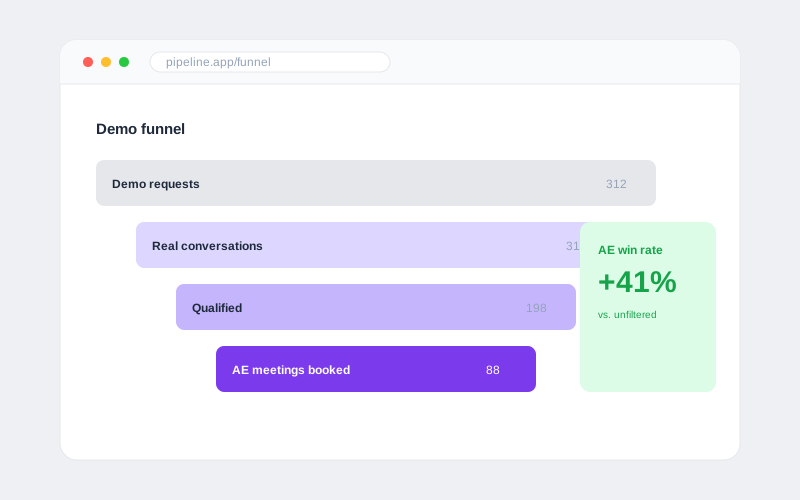
Count the demos your team gave last month. Now count the ones that turned into a second call. For most B2B SaaS teams the gap between those numbers is the single biggest waste in the funnel — hours of expensive AE and SE time spent walking tyre-kickers, students, and competitors' interns through the product.
The obvious fixes all backfire, because they reduce unqualified demos by adding friction that reduces qualified ones too. Here's what actually works. (The short version: qualify in the demo, not before it — book a demo to see how.)
Why the usual fixes backfire
Longer forms filter for patience, not fit. Your highest-intent buyers — the ones evaluating three vendors this week — are exactly the people least willing to complete an eight-field form for the privilege of waiting two days.
SDR screening calls add a human gate, which means a delay and an extra meeting. Serious buyers experience this as being made to pitch you before you'll show them anything.
Calendar delay — "next available demo slot: Thursday week" — is the worst of all. High-intent buyers are moving fast precisely because they're high-intent. They book a competitor's demo the same afternoon.
All three share a flawed premise: that qualification must happen before the demo. Flip that premise and the trade-off disappears.
Qualify in the demo, not before it
The demo itself is the best qualification tool you have — if it's a conversation. What a buyer asks, how they describe their current setup, and how they respond to discovery questions tells you more than any form ever will. The only reason we don't use the demo this way is that human-delivered demos are too expensive to give everyone.
That's the constraint an AI demo agent removes. Sonesse gives every requester a live, voice-first demo instantly — and runs discovery inside it, scoring each buyer against your ICP in real time. The unqualified still get a genuinely useful demo. They just don't get your AE's Tuesday afternoon.
The mechanics
- No gate at the top. Anyone can start a demo, instantly. Volume of requests stops being a problem the moment requests stop costing rep time.
- Discovery happens conversationally. Pain, current tools, timeline, team size — asked naturally, the way your best reps ask, and captured as structured signal.
- Scoring is automatic. Every conversation ends with an ICP score. You define the bar; only buyers who clear it reach a calendar.
- Handoffs arrive warm. Your AE gets the conversation summary — questions asked, objections raised, score — before the meeting starts.
We've written a fuller playbook on this in how to qualify demo requests automatically.
What to measure
If you change this, track three numbers.
AE demo-to-opportunity rate. This is the headline. When humans only meet scored buyers, the conversion rate of human-led meetings should climb sharply — that's your reclaimed capacity showing up as pipeline.
Time-to-first-demo. Measure from demo request to a buyer actually seeing the product. Instant beats every SLA you've ever set.
Coverage. What share of demo requests received a demo at all? With gating, the honest answer is usually a minority. Without it, it's everyone — including the 2am visitor from a time zone you don't staff, who today bounces to a competitor with a faster front door.
What about the edge cases?
Two objections come up every time a team considers removing the gate. First: "won't competitors just demo our product?" They already do — via trial accounts, review-site screenshots, and your own webinar recordings. A conversational demo actually gives you more control, not less, because you set guardrails on what the agent will and won't discuss: pricing specifics, roadmap, competitive comparisons. Taught once, enforced in every conversation, at any hour.
Second: "what if the agent gets something wrong with a real buyer?" This is worth taking seriously, and the answer is scope. The agent is trained only on your approved docs and playbooks, and its job at the first touch is bounded — demo, answer, qualify, route. Complex commercial questions get flagged for the human handoff rather than improvised. Compare that failure mode honestly with the status quo: a tired rep freelancing an answer on their ninth demo of the week.
Unqualified demos aren't the enemy
Here's the reframe worth internalising: unqualified demo requests were never the problem. Unqualified demands on your team's time were. A researcher poking around your product with an AI agent costs you nothing and might name-drop you in a report. A student clicking through becomes a user at their next job. The goal isn't fewer people seeing your product — it's making sure human hours are only ever spent on buyers who cleared the bar.
Give every requester a demo and your team none of the unqualified ones — book a demo.