
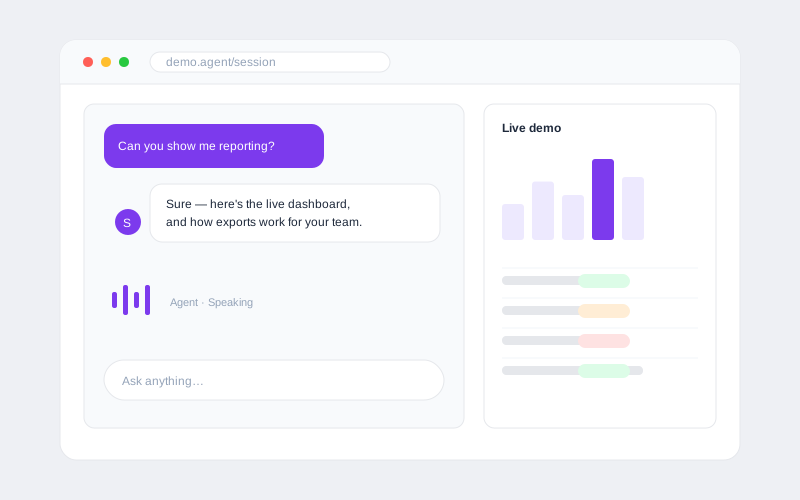
An AI demo agent is a conversational AI that gives your product demo as a live, two-way exchange — answering buyer questions, adapting to their use case, and qualifying them as it goes. For B2B SaaS teams, it replaces the two weakest links in the funnel at once: the static demo asset nobody finishes, and the first-touch call your reps dread giving.
This piece covers what an AI demo agent actually does, how it differs from the tools it's often confused with, and how to judge whether your funnel needs one. Or just book a demo and judge for yourself.
What an AI demo agent actually does
Strip away the category noise and the job description is simple: do what a good first-call sales engineer does, instantly and at unlimited scale.
- Demos the product live — walks through real workflows, focused on what this buyer cares about rather than a fixed script
- Answers questions in real time — integrations, security, pricing structure, edge cases — trained on your docs and playbooks
- Runs discovery — asks about pain, current setup, and timeline the way your best reps would
- Qualifies against your ICP — scores every conversation so your team only ever meets buyers worth meeting
- Books the meeting — routes qualified buyers to an AE warm, with the full conversation attached
Sonesse does this voice-first: a prospect clicks a link and the conversation starts in the browser — no download, no form, no scheduling.
What it isn't
Not a website chatbot
Chatbots deflect questions; a demo agent gives demos. The difference is depth. A chatbot answers "what integrations do you have?" with a link to a docs page. A demo agent shows the integration working, then asks which tools the buyer's team uses today — because that answer is a qualification signal.
Not an interactive product tour
Click-through tours from vendors like Storylane, Walnut, and Navattic let buyers explore scripted paths through product screenshots. Useful — but one-way. The buyer can't push back, ask about their edge case, or get a straight answer on pricing. A demo agent is built around exactly those moments. We've compared the approaches directly in interactive product demo vs live conversation.
Not a recorded video
A demo video ages the day you record it and answers no one's questions. An agent is retrained by updating the documents it learns from.
Why B2B SaaS needs this now
Three funnel problems have been getting worse for years, and they compound.
Buyers self-serve until the last minute. The modern B2B buyer does most of their evaluation before they'll speak to sales — and increasingly resents being forced onto a call to see basic product functionality. Demo-gating filters out your best prospects along with your worst.
First-touch demos don't scale. Every inbound demo request costs an expensive rep thirty minutes, whether the prospect is a genuine buyer or a curious browser. Most teams respond by adding friction — forms, SDR screens, calendar delays — which loses exactly the high-intent buyers moving fastest.
Qualification happens too late. When discovery only happens on the call, your team finds out a lead was unqualified after the time is already spent. We've broken down the fix in how to qualify demo requests automatically.
An AI demo agent addresses all three with one mechanism: every prospect gets an instant, real conversation, and every conversation produces a qualification signal. Coverage becomes 24/7 across every time zone. Rep time gets spent only on scored, warm buyers.
How to evaluate an AI demo agent
- Is it genuinely conversational? Voice-first, interruptible, able to go off the happy path — or a scripted flow with a text box attached?
- Does it qualify, or just engage? Engagement metrics aren't qualification. Look for real ICP scoring from conversation content.
- What does training look like? The right answer is your existing assets — docs, playbooks, call recordings — not a demo you have to storyboard.
- Does context persist? A returning buyer should pick up where they left off, not repeat themselves.
- How does the handoff work? Qualified buyers should reach your AEs warm, with the conversation summary attached — piped into the CRM and channels your team already uses.
Getting started without a big project
The setup cost is lower than most teams assume, because the training material already exists. Your product docs, your sales playbooks, and a handful of your best recorded demo calls are the entire input — the agent learns your product, your story, and your objection handling from assets you've already made. From there it's a link on your site where the demo button used to be. No engineering sprint, no demo environment to storyboard and maintain, and the first version is live in well under an hour. Start it on one segment — inbound requests from your smallest tier is a common choice — measure the qualification quality for two weeks, then widen the funnel it covers.
The bottom line
The demo used to be the reward for surviving your sales process. An AI demo agent makes it the entry point instead — a live conversation that educates the buyer and qualifies them for you, at whatever hour they show up. The SaaS teams adopting this aren't replacing their sales team; they're refusing to spend it on first touches.
See what a live, conversational first touch feels like — book a demo.